

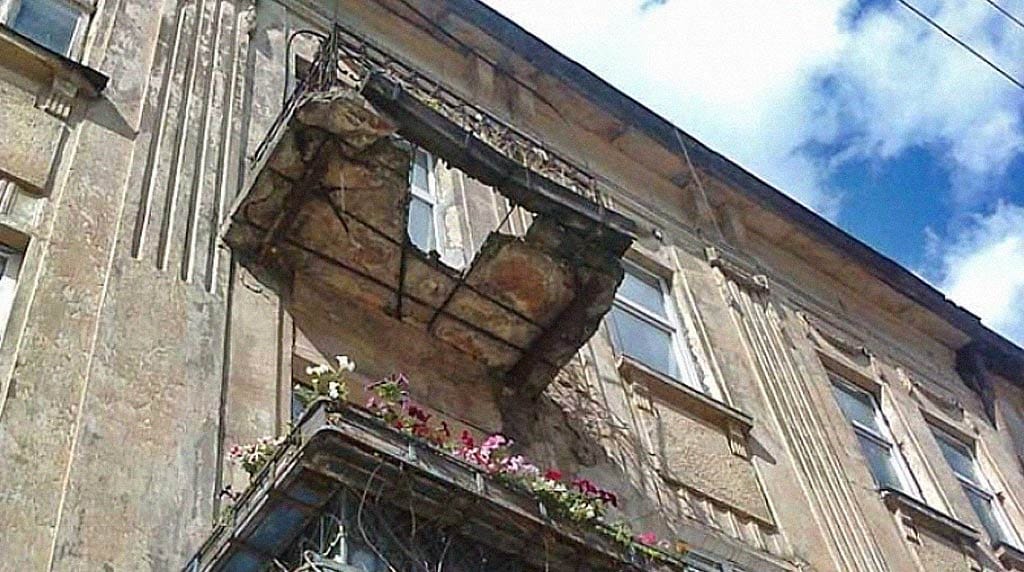
In Ukrainian cities, you can often find ruins of once beautiful architectural creations that are no longer being used
Why is this happening? And who is to blame?
Ukraine is a country with a rich history. A significant number of cities are listed as historical and are subject to legislative protection.
Any urban transformations in the historical areas of such places must be controlled by cultural heritage protection authorities.
But in most of them, in the historical parts of the city, there are frequent ruins of once beautiful works of architecture, next to which stand recently erected new buildings with glass facades.
In Ukraine, it is customary to blame business for this, which is supposedly ready to destroy any monument for the sake of profit, but is this really so?
According to the legislation, architectural and urban planning monuments are divided into three types:
- Monuments of local importance – played a significant role in the history of the settlement or are associated with historical local figures.
- Monuments of national importance – played a significant role in the history of the country or are associated with historical prominent figures.
- Newly discovered monuments – objects that have certain features of a monument and are subject to protection until a final decision is made on their status.
However, each monument must meet the criterion of authenticity. This means that it must largely preserve its form and material and technical structure, historical and cultural layers. In other words, not everything that is old is a monument of architecture and urban planning.
Scientific documentation must be compiled for each monument and its passport must be made, which clearly establishes what exactly constitutes the value in a particular building (facade, stucco molding, arches, etc.). However, from practice, I can conclude that a significant part of the monuments do not have such a document, especially this applies to newly discovered objects.
Often, cultural heritage protection authorities themselves do not know whether there is really something valuable in the building, but have included it in the list of protection simply based on the criterion of antiquity and, since there is no period within which a decision must be made on such an object, this issue hangs for decades. The city of Kyiv is a very vivid example of this.
And what should the owner of such buildings do in this case?
Ukrainian legislation very strictly regulates the possibility of carrying out construction work on monuments and allows only restoration work, before which a significant number of approvals must be obtained. That is, legally, it is forbidden to change the internal wall partition, ceiling or doors between rooms on a monument.
Unfortunately, it is not always possible to effectively use such buildings in modern realities, because some of them do not even contain engineering networks that are minimally necessary for its comfortable use, and therefore, if the building is restored completely without changes, it will be impossible to use it.
And even if someone still dares to do this, they will have to go through all the circles of bureaucratic hell and spend a significant amount of time and money. Therefore, the owners of what is left of the cultural heritage have been knocking on the doors of the cultural heritage protection authorities for years to find the optimal solution, while the historical value stands destroyed and covered with a screen.
As a result, a socially responsible business, without risking taking responsibility for violating the law, sells the object, as a result of which architectural monuments, which supposedly should have the highest price, are valued lower on the market, because their use drags the owner into a bureaucratic quagmire.
As a result, since such an object is not of significant economic interest to a socially responsible business, the monuments may end up in the ownership of the same businessmen who are ready to disregard Ukrainian legislation and social interests.
Under such conditions, the state or local community, upon each alienation of a monument, has the preemptive right to buy it out of private ownership and must necessarily waive such right in writing before each sale to private individuals. In practice, I have not yet encountered cases where the state would exercise its preemptive right.
So, in our realities, a standard of bureaucracy has been created, when an agency created specifically to preserve the cultural heritage of past generations does everything in its power to ensure that the heritage remains ruins covered by a screen.
Therefore, to preserve history, it is still necessary to make certain concessions, for example, obliging owners to preserve the facades of buildings and those interior elements that truly have historical value, and allowing other parts of the building to be converted to modern realities.
It is necessary to put things in order with the newly discovered traces, establish a period within which the study should be conducted and a final decision made on their status, establish clear rules of the game and develop a clear algorithm of actions for each monument with the limits of permitted transformations, so that its potential buyer consciously incurs future significant costs for its restoration and is sure that the building will be able to stand until the time of obtaining permits, and bureaucratic procedures will not be delayed for more than a dozen years.
If optimal conditions are created, the state will be able to restore the historical areas of cities destroyed by time at the expense of socially conscious business, which values historical heritage and is ready to sacrifice its profits for their preservation.
To do this, it is necessary to change the approaches of the regulatory bodies to the situation so that they do not only say “how not to do it”, but also listen to business proposals “how to” breathe new life into the object and at the same time preserve precisely those of its elements that constitute historical value.
As a result, it will be possible to find a balance point between social and economic interests and significantly improve the appearance of buildings of historical value.
Yuriy Khapko, lawyer, Ph.D., senior partner of TOTUM LF
