

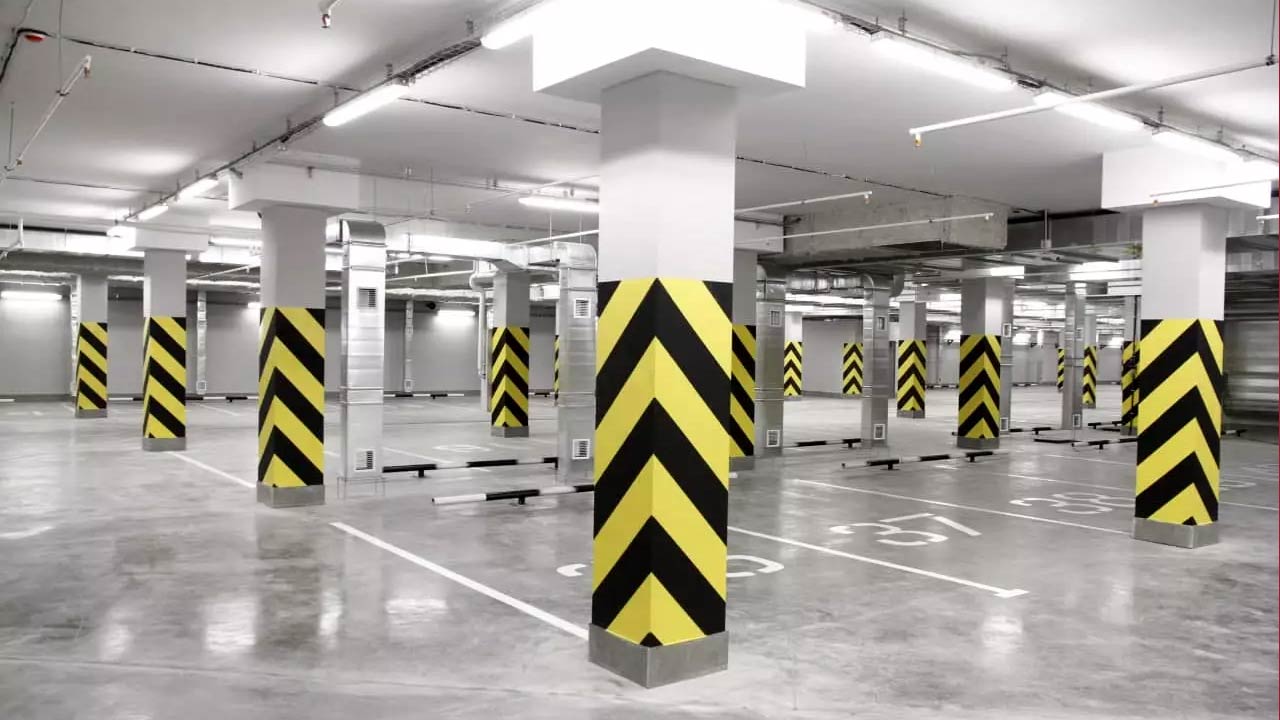
The lack of parking spaces, blocked yards and sidewalks, and very soon the first tangible fines – this is the reality of parking for most residents of large cities
Instead, developers face the opposite task – how to make yards without cars friendly, and at the same time create conditions for car owners.
Recently, a video recording system for traffic violations began operating in Ukraine.
In the first days, it recorded tens of thousands of violations, but so far this only applies to cars in motion.
Almost two years ago, new parking rules came into force in Ukraine. For example, now you can not wait for the car owner to hand him a fine.
It is enough to take a photo of the violation and send the receipt by mail. But the rules have not yet come into effect, because the information collection and photo recording system has not yet worked.
We can assume that this will change in the near future. Photo recording of parking rules will become part of a new platform for analyzing information from cameras.
The infrastructure for data collection and analysis will start accepting information not only from cameras, but also from inspectors and police officers. The rest of the process will remain unchanged.
High parking fees mean fewer cars
Strict parking regulations have long been used in Europe to curb traffic in large cities.
Thanks to this, even old European capitals, which were also built on a radial principle and are not adapted to car traffic, do not have such big problems with traffic jams.
This is despite the fact that in Paris or Berlin the level of motorization is one and a half to two times higher than even in Kyiv.
In European cities, an hour of parking in the center costs from 1 to 7 euros.
This is a lot, and therefore even people with money often choose to go to work by public transport.
There are also developed underground parking systems. If you don’t have enough street capacity, you don’t need to additionally block some of them with cars that just stand there and wait for their owners.
In addition, public parking lots are a large segment of business.
For example, large hotels or shopping centers often build parking lots several floors down, and in terms of the total number of parking spaces, such parking lots exceed the needs of the institutions themselves.
Land in the center of a European capital costs a lot – here even Kyiv cannot yet compete with the cost of a hundred square meters.
Business seeks to make as much money as possible, but often cannot build skyscrapers due to restrictions on the height of buildings.
As a result, entrepreneurs build objects deep. But if renting rooms on the “minus third” floor would be strange and impossible, making a parking lot there is easy.
Offering places for 20-30 euros per day, a hotel can receive the same profit from each square meter of area as from renting rooms. After all, there are no costs for decoration, cleaning, changing and washing linen.
Parking lots in the form of separate multi-level structures are also common in Europe. A private investor builds a parking lot in a crowded city.
He sets a commercial price, and people decide for themselves how they want to get there – by car or by metro. The payback period of such parking lots can usually be compared with other commercial real estate objects.
In contrast, in Ukraine, the construction of private parking lots, in fact, does not make any economic sense.
The strictness of our parking rules is compensated by the complete non-obligatory nature of their implementation.
People can park anywhere – on the lawn, near a bus stop or in a public transport lane – and not get any penalty for it.
It is very difficult to convince motorists to park in a parking lot, even if it costs a symbolic 10-25 hryvnias per hour.
As long as people can park illegally without paying or fines, no investor will invest money in the development of a convenient parking infrastructure, as in Europe.
Parking lots in buildings
The situation in the residential segment is different. If for a comfort-class residential complex the presence of underground parking is a good advantage, then in a business-class building you simply cannot do without a large multi-level parking lot.
Although even here there are paradoxes when owners of apartments for several thousand per square meter, and with several Lexuses or Ranges, do not want to spend extra money on parking. They leave their cars in guest parking lots, or park outside the residential complex.
In addition to respecting the interests of car owners, the presence of underground parking lots also allows you to implement the concept of a yard without cars.
For a large number of potential buyers, this is a significant advantage when they compare and choose residential complexes.
The trend can be especially observed now, when, due to quarantine, people have become more appreciative of green areas and other places to relax on the street. Of course, the implementation of a yard without cars is not possible if the complex does not have underground parking.
Only in the economy segment do buyers show almost no interest in underground parking.
The cost of parking is even higher compared to an apartment, and developers often do them not for the purpose of earning money, but to increase the comfort of residents.
On the other hand, in economy, people do not want to buy an additional 15-20 meters to the apartment, and prefer to leave their cars under the windows or in guarded parking lots further from the house.
However, the share of such housing is constantly decreasing – in recent years, among new residential complexes, the number of economy complexes has fallen from 40% to a little more than 10%.
Today, parking is a big problem in Ukrainian cities. Until violations are recorded and real fines are imposed, no investor with money and plans to develop parking infrastructure will come to this segment.
And although the high cost of parking and tough fines for improper parking will not add popularity to local authorities, this is the only real method of combating traffic jams.
A completely different picture of the “world after tomorrow” is shown by the residential segment. In residential complexes of comfort class and above, buyers want to get yards without cars, but with areas for recreation, sports and even barbecue.
And already now many of them are ready to pay for square meters not only for themselves, but also for their cars.
Paradoxically, but as much as parking lots are not in demand among citizens outside their homes, they have become a “must have” in new residential complexes.
So, in Ukraine, it is the residential sector that can be considered the driver of the transition from chaotic parking to civilized parking.
OLEKSII KOVAL, Project Manager of Perfect Group
