

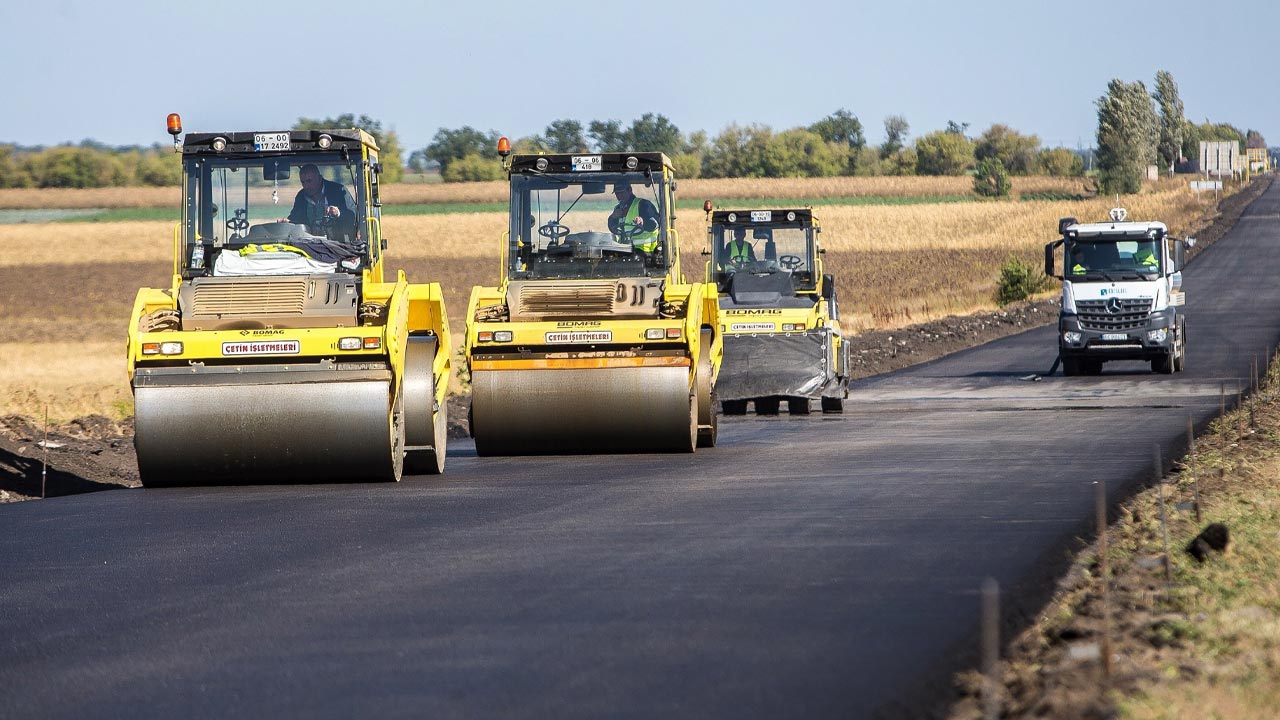
It is hard not to notice the active development of roads throughout Ukraine. Currently, in every region you can see newly repaired sections of roads, as well as observe the restoration of road surfaces in the process
The “Large Construction” program, initiated by the state and Ukravtodor, provides for even more investment in road infrastructure.
Thus, by the end of 2020, the program plans to build 6,500 km of roads. But Ukraine needs more far-sighted plans, which is why the State Roads Agency of Ukraine proposed the concept of a targeted economic program for the construction of roads with cement concrete pavement for 2021-2025.
The Association of Cement Producers of Ukraine “Ukrcement”, State Enterprise “DerzhdorNDI”, and the Association of Road Workers of Ukraine also participated in the development of the program. The initiators plan to address the Prime Minister of Ukraine Denys Shmyhal with a corresponding appeal.
Ambitious goals: transit potential, increased GDP and additional jobs
Ukravtodor’s plans are strategic and innovative: cement concrete pavement, which is almost not used in Ukraine, should now become the main driver in improving road infrastructure.
The feasibility of the state target program is dictated primarily by the increase in the number of heavy-duty vehicles on Ukrainian roads, and therefore the increased load on asphalt pavement.
The state already has an existing target economic program for the development of public roads of state importance for 2018-2022, but it does not provide for the systematic construction of cement concrete roads, as it focuses on the systematic restoration of road sections according to the route principle, which does not depend on the technology of work and the type of pavement.
The Program for 2021-2025 should be a supplement to the Program for 2018-2022 and its logical continuation, taking into account the realities of transport and road surface loads.
With this Program, the authors plan to solve several urgent issues at once. In addition to improving the quality of roads and traffic safety, the goal of the Program is to improve the country’s transit potential and investment climate, especially in the heavy-duty transportation sector, to create a developed road infrastructure with a combination of high-quality transport connections of promising territorial clusters.
At the same time, the Program is aimed at increasing the use of the potential of domestic industry and creating new jobs by building roads with a coating based on the local component.
It is precisely the localization of construction and reducing import dependence on oil products, according to the authors of the Program, that should activate the country’s economy, increase GDP, and most importantly, help effectively use budget funds by extending the “life cycle” and the period between repairs of cement-concrete roads.
According to Ukrcement, Ukraine will be able to save billions of hryvnias. The effective use of funds will also lead to an increase in the revenue side of budgets of all levels due to the return of funds in the form of taxes and mandatory payments.
It is planned that the implementation of the program will allow increasing the number of cement concrete roads to 5% in 2025 and to 30% by 2040.
Does Ukraine really need cement concrete roads?
According to state construction standards, for roads where more than 15% of heavy-duty vehicles are expected, and the load parameters of which exceed the design ones, only rigid road surfaces should be designed. However, in Ukraine, only 1.4% of roads are currently covered with cement concrete.
Unlike non-rigid road surfaces, rigid road surfaces contain layers whose strength practically does not depend on temperature, humidity and load. This is especially important for the southern regions of Ukraine, where the average monthly temperature is more than +23 °C and usually lasts more than 70 days. At temperatures above +28 °C, the modulus of elasticity of the asphalt concrete surface decreases, and this is one of the reasons for the formation of ruts and related defects.
The properties of cement concrete surfaces practically do not depend on temperature and humidity, and therefore such a surface is able to better distribute the load at any time of the year. Thanks to this, even after a long time, the cement concrete pavement shows little wear, allows to increase traffic safety in the dark, and extend the “life cycle” of roads.
Prospective benefit
However, the fragility and destruction of asphalt concrete roads are not the only challenge that the state faces when planning the development of road infrastructure. Ukrcement has calculated that compared to the costs of roads with asphalt concrete surfaces, the construction of roads with cement concrete surfaces allows saving up to 70% of costs.
Due to the structural features of the main component of asphalt — bitumen — such roads have a short warranty period: 5-8 years. The use of cement concrete technologies provided for by the Program will allow increasing this figure by 3-5 times.
In other words, innovative technologies for cement concrete surfaces, despite the high initial investments, ultimately help save funds from the State Road Fund (SRF), as well as funds from the state budget, international financial organizations, and local budgets allocated for the construction, repair, and maintenance of roads.
Cement concrete roads have a number of other advantages. For example, such a coating is environmentally friendly, which makes it possible to improve the environmental situation in certain regions, in particular in Zaporizhia, Donetsk, Luhansk, Dnipropetrovsk, Mykolaiv, Kirovohrad regions, as well as other regions where large industrial facilities are located. Waste from such enterprises can be used as aggregates in cement-concrete mixtures, as provided for by regulatory documents.
However, the authors of the Program consider the localization of the main component to be the most important. While bitumen is used for laying asphalt roads, which is created from refined oil and accounts for about 60% of the cost of asphalt, the level of localization in the construction of cement concrete roads is over 90%.
Large reserves of the main material for hard pavement — cement — allow stabilizing the cost. All this creates the prerequisites for additional investments in the national economy.
Financial question and three answer options
As for the financial issue, the authors of the Program have three options for solving the problem.
The first is to minimize the costs of the State Road Fund and leave the current state of affairs, that is, to continue to build asphalt concrete roads. Of course, this option completely eliminates all the goals of the Program, but saves state funds.
The second option is to attract funds from investors and international financial organizations. This will allow roads to be gradually built on important areas, while saving state funds. The disadvantages of this option are dictated by the difficult situation in the global economy due to the corona crisis. In addition, the financing process may be delayed, and also create additional burdens on local budgets due to the payment of interest on financing.
And finally, the third option is the most optimal. It involves financing clearly defined tasks and measures for the construction of roads with cement concrete pavement using state budget expenditures with the possibility of attracting funds from the local budget and other sources of financing.
Ukravtodor notes that the advantage of this option is the formation of a stable source of financing, as well as the possibility of systematic construction of roads with cement concrete pavement according to the route principle. As a result, this will ensure the development of domestic production of building materials and the creation of additional jobs.
Meanwhile, Ukrcement believes that the third option should provide for a competitive choice of the type of road surface based on the projected cost of “life cycle” costs, temperature conditions, and real loads during operation. That is, according to cement manufacturers, it is necessary to create some competition between rigid and non-rigid types of coatings and thus ensure effective distribution of budget funds.
The estimated amount of financing required for the implementation of the Program is 109.726 billion hryvnias. The active stage of implementation is planned to begin at the very beginning of next year. If the government approves the project, in Ukraine the number of modern, durable roads will increase almost 5 times in 5 years, which will open up wider opportunities for the entire economy of the country.
Author: Anna Gergel
