

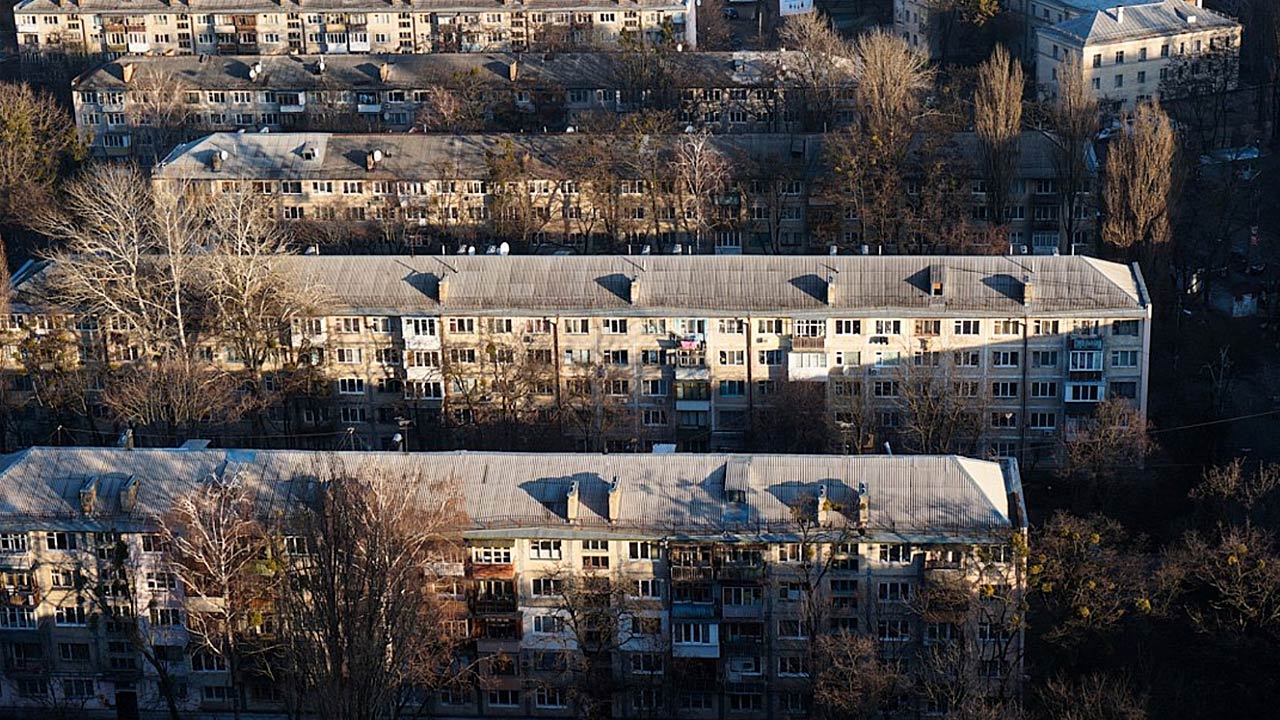
According to the State Statistics Service, as of January 1, 2020, 69% of Ukrainians live in cities
And, according to a 2018 study, almost three-quarters of the city’s residents live in houses built in the 1960s-80s. Another 15% have homes built before the 1960s. Every tenth family lives in relatively new housing built during the years of independence.
According to official statistics, in general, almost 45% of housing in Ukraine has never undergone major repairs.
At the same time, according to the Ministry of Development of Communities and Territories, in Ukraine, as of January 2020, the number of emergency and, according to official terminology, “dilapidated” or worn-out houses does not exceed 1% of the total number of houses, both multi-storey and private, both in cities and villages.
From time to time, in Ukraine, the idea of modernizing “Khrushchev” or (usually at the initiative of developers) demolishing old five-storey buildings that, supposedly, have served their term, and building new, taller and more spacious houses in their place is returned to.
In 2006, a corresponding law was even adopted. According to this law, decisions on comprehensive housing reconstruction are made by local governments. They, in turn, approve the relevant programs.
However, there are currently no large-scale examples of the application of this law – successful or not. And the relevant ministry – the Ministry of Community and Territorial Development – wants to change it somewhat.
At the same time, as Oleksandr Sergienko, director of the analytical and research center “City Institute”, argues, only dilapidated and dilapidated buildings should be demolished.
“It makes no sense to overhaul such housing,” says the expert.
But regarding the rest of the so-called “housing stock,” the expert says, a very balanced approach is needed. It’s not for nothing that the so-called “Stalinist houses,” built before the 1960s, are still popular on the secondary market.
“As for the Khrushchevs, which were designed for 60 years, this was a kind of reinsurance on the part of the designers,” the head of the “City Institute” insists. “If a standard, typical Khrushchev-panel house does not crack in the first 3-5 years, when the foundation shrinks, then it can stand for a very long time. Of course, it is necessary that the roof does not leak and the basement is dry. With normal operation, such houses can last a very long time.”
The same applies to high-rise buildings from the 70s and 80s, the expert says.
The chaos is not in the closets, but in the heads?
The main problem with the condition of the vast majority of housing in Ukraine, according to Mr. Sergienko, is not its age, but the way the housing ownership system works in Ukraine.
Only in recent decades, “when people build with their own money,” has there been an understanding that the entire house, not just what is inside the apartment, is property and must be looked after, says Oleksandr Sergienko, and he admits: “the rest — 90% of the housing stock — is gradually wearing out.”
“The problem for the housing stock in our country is that apartments were distributed to residents through the privatization mechanism, but people have neither the awareness nor the financial ability to maintain their homes,” the expert explains.
“The Constitution of Ukraine and the Civil Code of Ukraine clearly state that the owner of the property is responsible for the property, and in an apartment building, the co-owners, that is, the owners of apartments and non-residential premises,” recalls Tetyana Boyko, coordinator of housing, utilities and energy programs of the Civic Network “Opora”.
This principle was confirmed by the law “On the Peculiarities of Exercising the Right of Ownership in an Apartment Building”, adopted in 2015.
As the State Inspectorate for Urban Planning explained to BBC News Ukraine, while the building exists, it is “the owners or managers who must carry out a current inspection and periodic inspection of construction sites throughout the entire period of its existence”.
But once the problems are identified, who should solve them and at what cost?
Where to get money?
“Both the state and local governments should have programs that will help co-owners,” says Tetyana Boyko, and explains how: through reimbursement of part of the loan, interest rate, or simply by providing co-financing for individual activities.
Oleksandr Sergienko is also convinced that the state should only develop a mechanism that would allow maintaining the housing stock in proper condition – people should be “given a fishing rod, not a fish.”
The expert is convinced that centralized financing from the budget, in addition to the fact that there is no money for it, will only work as a mechanism for abuse, but will not solve the problem.
Similarly, in his opinion, the mass demolition of old houses and the construction of new ones will not solve the problem, because the infrastructure will not withstand it.
“Look how they are now making point-to-point connections in communications, and people are starting to have interruptions in water and electricity. And both residents of old and new buildings are suffering,” says Oleksandr Sergienko.
Like Tetyana Boyko, he believes that “long” credit programs, which could be joined by residents of each individual house, who know best where and what is flowing in it, are perhaps the only effective method of resuscitating “dead” housing.
Positive “point” examples of such an approach already exist in Ukraine, but only in one area — the modernization of houses under the “warm loans” program and through grants from the Energy Efficiency Fund, which is financed by funds from the budget, financial support from the EU and the German government, and in cooperation with the IFC.
But mass lending for modernization or repair of housing in a country where even mortgages do not work very effectively looks questionable.
As for the mass reconstruction of old housing, here, says Oleksandr Sergienko, the classic example is Germany, which successfully modernized its “Khrushchevs” and “panels” inherited from the GDR.
“When Germany was unified, 70% of the Khrushchevs there, which were mainly in the territory of the former GDR, were renovated. Where possible, balconies and loggias were attached to the apartments, where possible, partitions were demolished. Communications were updated everywhere,” the expert says.
At the same time, he admits that although this process was not completely free for the residents of the buildings, the state played a leading role in it: “They could afford it, because Germany has the most powerful economy in Europe.”
In Poland, an example of which in housing modernization is also often mentioned, commercial and state banks provided housing associations (analogous to Ukrainian condominiums) with loans at 2-10% to modernize the housing stock. In addition, the association could win a grant and receive funding from the state to cover the interest on the loan. At the same time, the creation of such housing associations for apartment buildings was mandatory from the very beginning of the communal reform.
It seems that Ukrainians have two options: either realize that they are the owners not only of their apartment, but also of what is behind its door, and cooperate with their neighbors in one way or another to prevent the roof from leaking and the pipes from bursting, or be prepared for new and increasingly frequent accidents.
From my own experience as someone who lives on the top floor of a house with a leaky roof and a problematic attic, I can say that the first option is extremely difficult. People don’t want to or can’t do anything even when it’s literally dripping on their heads. But then the second option is inevitable and just a matter of time.
What about the pipes?
If the situation with the housing stock is extremely difficult, but not hopeless, then what is happening with the infrastructure – water supply, heat and sewage – looks even worse.
According to the Ministry of Community and Territorial Development, more than a third (35.6%) of water supply networks are in a state of disrepair or are worn out.
The condition of sewage networks is even worse. In general, 40% of water supply networks in Ukraine are “dilapidated and in a state of disrepair”.
According to the ministry, major repairs related to the water supply system should be carried out under the state program “Drinking Water of Ukraine 2011-2020”. However, this year’s budget does not provide funds for financing this program. The ministry expects that the program may be extended until 2025.
The situation with heat supply is even sadder: more than 44% of heating networks are in a state of disrepair or in a state of disrepair.
According to the Ministry of Regional Development, over the past heating season in Ukraine, there were over 13,800 emergencies with heating networks, a third of which — 4,500 — in Kyiv.
The capital’s authorities claim that the city’s heating networks are 80% worn out. This year, according to Deputy Head of the Kyiv City State Administration Petro Panteleyev, over 100 km of pipes will be replaced in Kyiv, and over 450 million UAH will be spent on this. The same happened last year and the year before.
“The city invests about half a billion hryvnias every year in the modernization of heating networks, so that old worn-out networks, which literally crumble before our eyes after being dug up, can be replaced with modern and reliable ones,” said Mr. Panteleev, adding that both the city and the municipal enterprise “Kyivteploenergo” provide funds for this replacement.
And on a country-wide scale, according to the Ministry of Regional Development, the modernization of heating networks costs about UAH 64 billion. At the same time, according to the plan, in preparation for the next heating season, only 1.3% of emergency heating networks should be repaired.
The government is trying to improve heating networks with the help of external investments – since 2014, the program “Improving Energy Efficiency in the District Heating Sector of Ukraine” has been in effect, financed by a loan provided by the World Bank. But it should also be completed this year.
In addition, when preparing the state budget, at least 1% of the general fund should go to the regional development fund, and local authorities can submit their projects to this fund on a competitive basis.
In theory, repair work should also be financed by the investment programs of companies that supply heat to the population.
However, as Oleksandr Sergienko, director of the City Institute, claims, “now it is not profitable for either municipal or private companies to renew fixed assets. They simply use them, hammering them in until they fall apart.”
At the same time, the expert says, fines for failure to implement investment programs are mostly ignored, and then are still included in new, higher utility tariffs.
“As for infrastructure, there should probably be a targeted state program. Because cities will not pull the strings to replace networks, and collecting money for this through tariffs is unrealistic,” the expert says.
However, a targeted state program for a country whose budget deficit has reached a five-year record and is about 300 billion UAH looks just as unrealistic.
At the same time, the trouble that can happen at any moment will be quite real for those whose house is “torn” the next time.
Author: Anastasia Zanuda
