

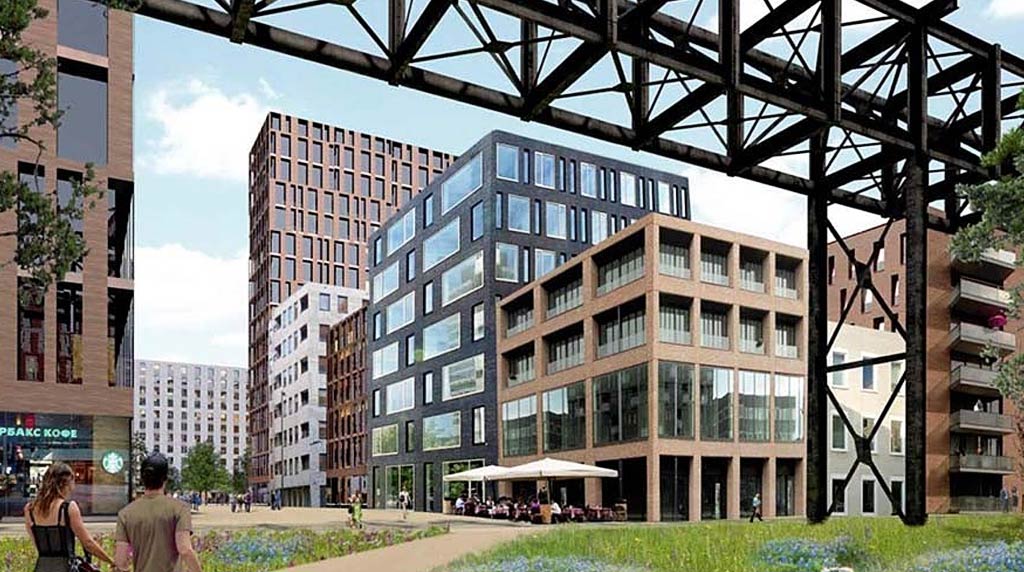
You won’t surprise anyone with new residential areas in cities anymore. However, you won’t be surprised by abandoned areas of former industrial facilities, where there is an old fence, and behind it a forest has already grown. However, such areas can be given a new life
Almost everyone has seen postcards with views of old Kyiv or maps of the capital from the 1920s, 1950s, 1970s. It is always surprising how much the city has grown since then. Where the last metro station is now, there was once not a single house.
In the residential area, which was completed before the collapse of the Soviet Union, only in the last 5 years have new modern neighborhoods appeared and a metro is being built.
Despite our nostalgic desires, Kyiv will not cease to be an economic magnet for ambitious Ukrainians. Therefore, the population of the capital will systematically increase.
How to solve the problem of industrial zones
However, the opportunities for expansion are becoming fewer and fewer. Kyiv is already leaning against satellite cities or forests, the destruction of which is a crime. Revitalization of industrial zones can help solve this problem.
The capital is littered with abandoned industrial areas from the last century. Some of them were once built on the outskirts or outside the city. Kyiv absorbed them long ago, building up neighborhoods around them. And some were built in the central areas of the capital.
The once powerful Podolsk industrial cluster can now boast only the Farmak plant and certain other facilities. Although some developers have already paid attention to this area.
So, a small part of the industrial zones has preserved historically valuable buildings. For the most part, these are large areas covered with asphalt and strewn with concrete box-like buildings. Former factories/plants have lost their functionality. And there are not so many entrepreneurs who want to revive production in logistically inconvenient places.
That is why we see these gray spots on the map of the capital, which do not perform almost any function. While in Kyiv there is a constant competition for territories for development. Unfortunately, the competition is often illegal.
Revitalization of Kyiv industrial zones is the most adequate tactic for solving the issue of the constant increase in the city’s population, which needs more and more housing. Perhaps it is not worth citing popular European examples, when old port warehouses and industrial zones were transformed into modern residential areas. You can hear in response: “Europe is a different world, where do we need them?” But this positive “different world” is gradually being implemented in the capital.
About the revitalization experience in Kyiv
One project aims to transform the vast territory of the former motorcycle factory into a residential quarter for the new creative class. If you take a walk there, you will see how this area is gradually coming to life.
Another one is being built on the territory of the exhibition center. On one side of the scale are hundreds of apartments with a modern ecosystem for the capital’s residents. On the other side is a huge paved area for events that are held at best 10 times a year (and keep in mind that there are several other exhibition areas in the capital). It doesn’t even make sense to compare which object is more important for the city in this particular area.
Or a residential quarter that is being built on the territory of one of Kyiv’s industrial zones on Degtyarevskaya Street. We are revitalizing this area, which is located not far from three metro stations, Pushkin Park, and the zoo. Now imagine, the territory, which will soon benefit thousands of Kyiv residents, for many years simply stood as a concrete spot next to the historical places of Kyiv.
Although we clearly understood at the design stage that when the planned project is implemented, this territory will become the face of Shulyavka. We also see how, in addition to us, other developers are trying to fill this concrete spot with meaning. By the way, this industrial zone is a close neighbor of the other project I mentioned above. That is, soon the capital will be able to boast of a district renovated according to world standards.
What about “illegal construction”?
There is another, no less important, side to the issue of revitalization of industrial zones. The phrase “illegal development” can confidently compete with “metro to Troyeshchyna” as a negative phrase – a symbol of the capital. Unscrupulous developers, violating the law, put houses on any free piece of land and at the same time negatively set Kyiv residents against all developers.
People have a false impression that everything is being built illegally in Kyiv. And in general, it is necessary to ban building in the capital. But the above-mentioned problem of population growth is not going away.
Large abandoned industrial zones do not perform the necessary functions and already occupy territories. Their renovation allows not just to build residential complexes point by point, stealing space from Kyiv residents, but to update entire districts without harming local residents.
On the contrary, they will receive a new quality of the environment and infrastructure. Agree, it is much more pleasant to have in the neighborhood not a dark area with warehouses, fenced off by a fence, but new, well-lit buildings, for example, with a cozy cafe.
Revitalization is the return of life to the extinct areas of the capital. It is better to fill the huge concrete spots from the past with new meaning for the residents of Kyiv.
Ramil Mehtiyev, Executive Director of the Ukrainian development holding “ENSO”
