


The profession of a builder should be prestigious!
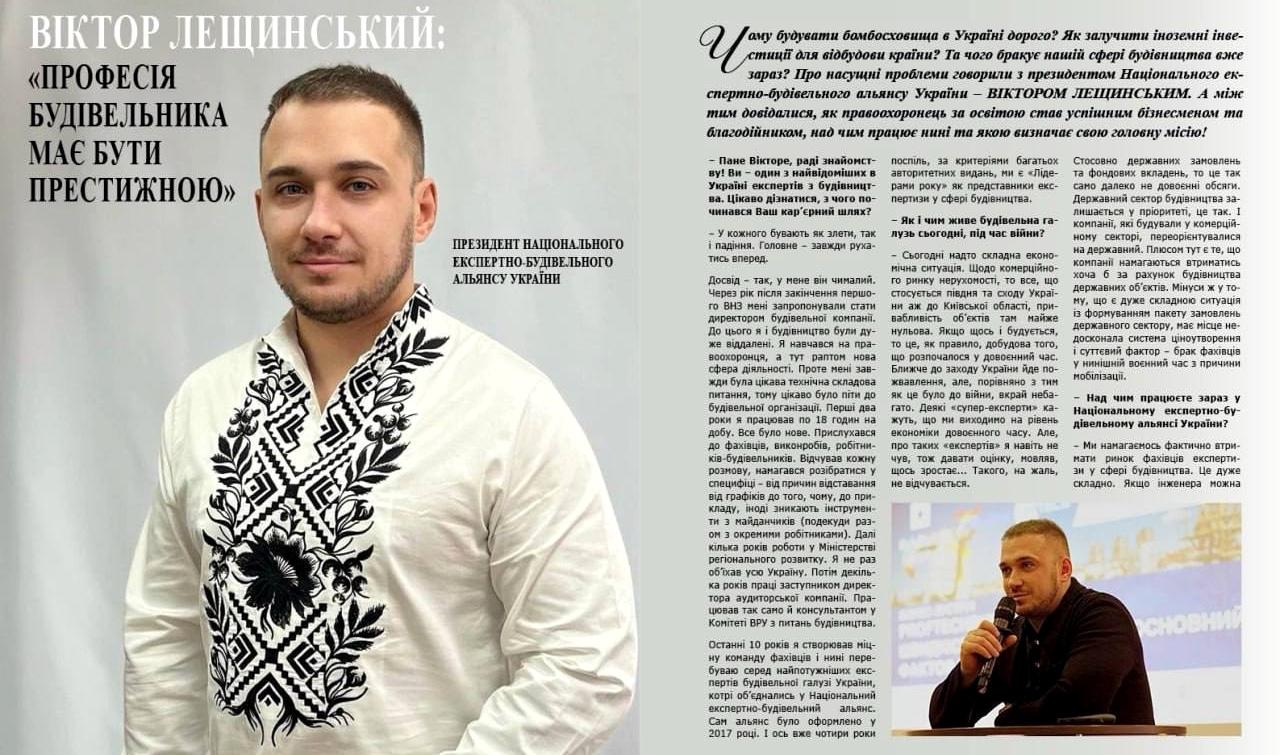
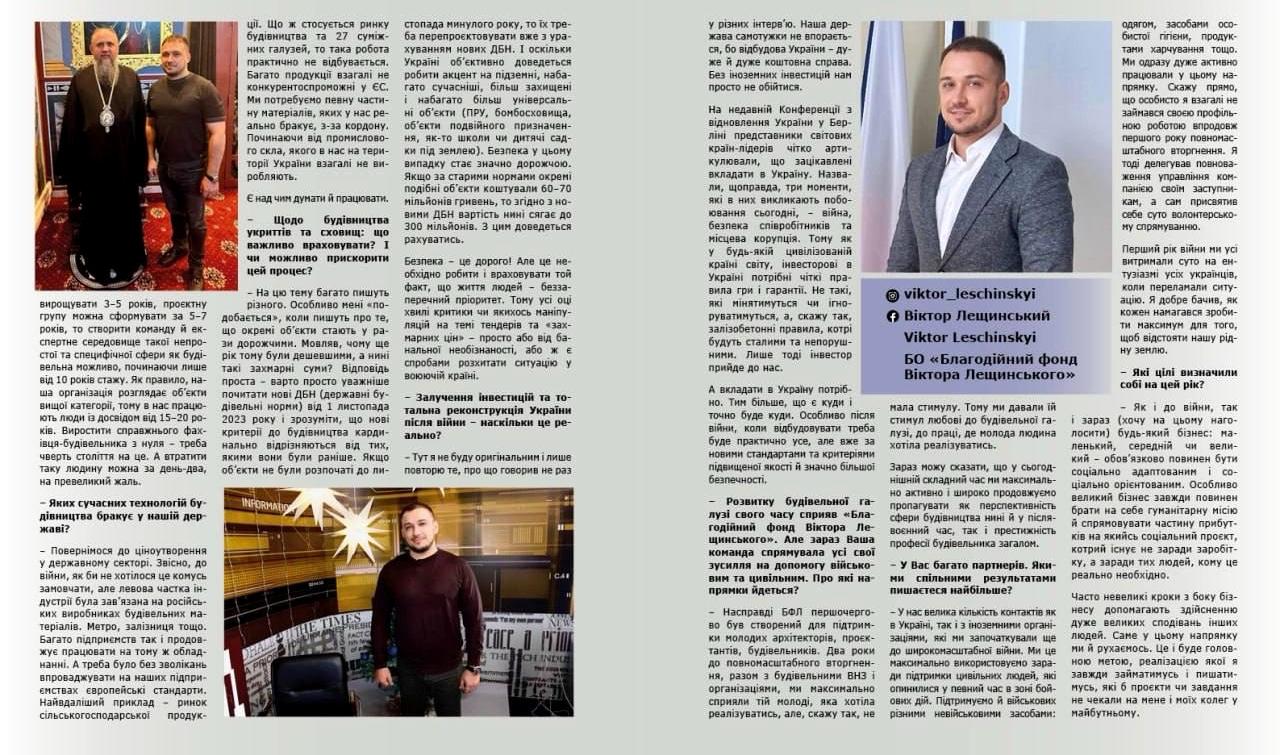
A long interview with MILLENIUM CLUB magazine (July 2024) with the President of the National Expert Construction Alliance of Ukraine, VIKTOR LESCHYNSKY
– Mr. Victor, nice to meet you! You are a successful businessman and one of the most famous construction experts in Ukraine. I am interested to know how your career path began?
– Everyone has ups and downs. The main thing is to always move forward.
Experience – yes, I have a lot of it. A year after graduating from my first university, I was offered to become the director of a construction company. Before that, I and construction were very distant. I was studying to be a law enforcement officer, and then suddenly a new field of activity. However, I was always interested in the technical component of the issue, so it was interesting to go to a construction organization. For the first two years, I worked 18 hours a day. Everything was new. I listened to specialists, foremen, construction workers. I felt every conversation, tried to understand the specifics – from the reasons for the lags from the schedules to why, for example, tools sometimes disappear from the sites (sometimes together with individual workers). Then – several years of work at the Ministry of Regional Development. I traveled all over Ukraine more than once. Then several years of work as deputy director of an audit company. I also worked as a consultant in the Verkhovna Rada Committee on Construction.
Over the past 10 years, I have been building a strong team of specialists and am now among the most powerful experts in the construction industry of Ukraine, who have united in the National Expert Construction Alliance. The alliance itself was formed in 2017, and for four years in a row, according to the criteria of many reputable publications, we have been “Leaders of the Year” as representatives of expertise in the field of construction.
– How and what does the construction industry survive today, during the war?
– Today, the economic situation is too difficult. As for the commercial real estate market, everything that concerns the south and east of Ukraine, up to the Kyiv region, the attractiveness of the objects there is almost zero. If something is being built, it is, as a rule, the completion of what began in the pre-war period. Closer to the west of Ukraine, there is a revival, but, compared to how it was before the war, it is extremely small. Some “super-experts” say that we are reaching the level of the pre-war economy. But, I have not even heard of such “experts”, so to give an assessment, they say, something is growing… Unfortunately, this is not felt.
As for government orders and capital investments, these are also far from pre-war volumes. The state construction sector remains a priority, that’s true. And companies that built in the commercial sector have been reformatted to the state sector. The plus here is that companies are trying to survive at least through the construction of state facilities. The minuses are that the situation with the formation of a package of government sector orders is very difficult, there is an imperfect pricing system and a significant factor is the lack of specialists in the current wartime due to mobilization.
– What are you working on now at the National Expert Construction Alliance of Ukraine?
– We are trying to actually maintain the market for construction experts. It is very difficult. If an engineer can be trained for 3-5 years, a project group can be formed in 5-7 years, then creating a team and an expert environment in such a difficult and specific field as construction is possible starting from only 10 years of experience. As a rule, our organization considers objects of the highest category, so we employ people with 15-20 years of experience. It takes a quarter of a century to train a real construction specialist from scratch. And you can lose such a person in a day or two, to our great regret.
– What modern construction technologies are lacking in our country?
– Let’s go back to pricing in the public sector. Of course, before the war, no matter how much someone would like to keep quiet about it, but the lion’s share of the industry was tied to Russian manufacturers of building materials. Metro, railway, etc. Many enterprises continue to work on the same equipment. And it was necessary to integrate our enterprises into European standards without delay. The most successful example here is the agricultural products market. As for the construction market and 27 related industries, such work is practically not happening. Many products are not competitive in the EU at all. We need a certain part of the materials that we really lack from abroad. Starting with industrial glass, which is not produced at all in Ukraine.
There is something to think about and work on.
– Regarding the construction of shelters and storage facilities: what is important to consider? And is it possible to speed up this process?
– A lot of different things are written on this topic. I especially “like” it when they write that individual objects are becoming many times more expensive, they say, why were they cheaper a year ago, and now they cost such sky-high amounts? The answer is simple – you just need to read the new DBN (state construction standards) from November 1, 2023 more carefully and understand that the new criteria for construction are radically different from those they were before. If the objects were not started by November last year, then they need to be redesigned taking into account the new DBN. And since Ukraine will objectively have to focus on underground, much more modern, more protected and much more universal objects (PRU, bomb shelters, dual-purpose objects, such as schools or kindergartens underground), then security in this case becomes much more expensive. If, according to the old standards, individual similar objects cost 60-70 million hryvnias, then according to the new DBN, the cost now reaches 300 million. This will have to be taken into account.
Security is expensive! But, it is necessary to do this and take into account the fact that people’s lives are an undeniable priority. Therefore, all these waves of criticism or some manipulations on the topic of tenders and “sky-high prices” are simply either from banal ignorance, or are attempts to destabilize the situation in a warring country.
– Attracting investment and total reconstruction of Ukraine after the war – how realistic is it?
– I will not be original here and will only repeat what I have said more than once in various interviews. Our state will not cope on its own, because rebuilding Ukraine is a very, very expensive business. We simply cannot do without foreign investments.
At the recent Conference on the Restoration of Ukraine in Berlin, representatives of world leaders clearly articulated their interest in investing in Ukraine. They did, however, name three points that cause them concern today – war, employee safety, and local corruption. Therefore, as in any civilized country in the world, an investor in Ukraine needs clear rules of the game and guarantees. Not those that will change or be ignored, but, I would say, reinforced concrete rules that will be stable and unbreakable. Only then will the investor come to us.
And we need to invest in Ukraine. Especially since there is a place and there will definitely be a place. Especially after the war, when almost everything will have to be rebuilt, but according to new standards and criteria of increased quality and much greater safety.
– The development of the construction industry was once promoted by the Viktor Leshchynsky Charity Foundation. But now your team has directed all its efforts to helping the military and civilians. What areas are we talking about?
– In fact, BFL was primarily created to support young architects, designers, and builders. Two years before the full-scale invasion, together with construction universities and organizations, we maximally facilitated those young people who wanted to realize themselves, but, I would say, had no incentive. Therefore, we gave them an incentive to love the construction industry, to work where a young person wanted to realize themselves.
Now I can say that in today’s difficult times, we continue to actively and widely promote both the prospects of the construction sector now and in the post-war period, and the prestige of the construction profession in general.
– You have many partners. What joint results are you most proud of?
– We have a large number of contacts both in Ukraine and with foreign organizations, which we initiated even before the large-scale war. We use this to the maximum in order to support civilians who found themselves in a combat zone at some point. We also support the military with various non-military means – clothing, personal hygiene products, food, etc. We immediately worked very actively in this direction. I will say frankly that I personally did not do my core work at all during the first year of the full-scale invasion. At that time, I delegated the authority to manage the company to my deputies, and I devoted myself exclusively to volunteer work.
The first year – 2022 – we all survived purely on the enthusiasm of all Ukrainians when we turned the situation around. I clearly saw how everyone tried to do their best to defend our native land.
– What goals have you set for yourself this year?
– As before the war, so now (I want to emphasize this) any business – small, medium or large – must necessarily be socially adapted and socially oriented. Especially large business must always take on a humanitarian mission and direct part of its profits to some social project, which exists not for the sake of earning money, but for the sake of those people who really need it.
Often, small steps on the part of business help to realize the very big hopes of other people. This is the direction we are moving in. This will be the main goal, the implementation of which I will always be engaged in and proud of, no matter what projects or tasks await me and my colleagues in the future.
