

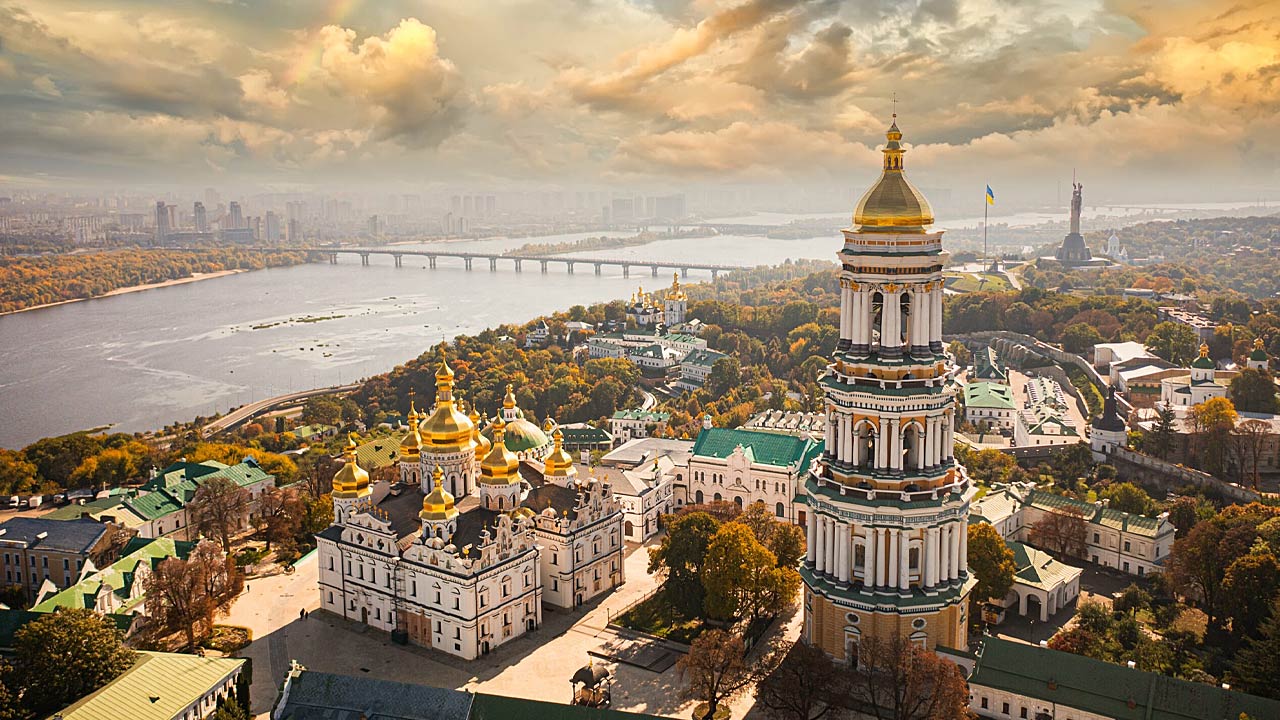
Architectural monuments often fall into disrepair and collapse due to lack of funding for their restoration, are demolished due to the construction of another shopping mall or residential complex, and suffer during armed conflicts, fires, or neglect
Technological solutions can preserve historical monuments for posterity or revive the appearance of buildings that have already been partially destroyed.
Such cases exist not only in the West, but also in Ukraine.
Notre Dame and the Arc de Triomphe: world practice
On April 16, 2019, the Notre Dame Cathedral in Paris caught fire in front of hundreds of people.
The fire in one of the most famous historical monuments in France was finally extinguished, but it led to the collapse of the spire and roof.
This will not be the first restoration of a cathedral with a centuries-old history. However, this is the only time a 3D model is being used to restore Notre Dame. It was created using laser scanning before the fire, when repair work was planned.
Immediately after the fire, the media and Internet users actively supported rumors that a model of the cathedral from the Assassin’s Creed game would be needed for the restoration. This was not confirmed: when recreating the appearance of Notre Dame, maximum detail and accuracy are important – down to the millimeter. Computer graphics cannot boast of this.
In addition, restorers and engineers are not only interested in the exterior, but also in the structure of the internal roof coverings. These details are known from surviving documentation, as well as from laser scanning.
The absence of a 3D model would have greatly complicated the restoration.
The Notre Dame case is the most striking example of using technology to recreate or restore a historical object. But it is not the only one.
In 2001, the Taliban in Afghanistan destroyed the Bamiyan Valley Cultural Landscape, created in the 6th century AD, calling them pagan idols.
In 2015, a couple of Chinese millionaires decided to recreate the appearance of the destroyed sculptures using holograms. They financed the creation of 3D images and installed a projector, which was later transferred to the Ministry of Culture.
In the summer of the same year, 150 people watched a light show – at night the projectors were turned on and projections of Buddha statues appeared before the audience in all their grandeur.
This idea was first proposed in 2005, but then the project was not supported.
Now the Bamiyan authorities cannot allow frequent use of the projector due to power supply problems, as reported by the NYT. But technology has made it possible to recreate the legendary statues.
Incidentally, it was the destruction of the Buddhas that gave impetus to the development of non-profit organizations whose goal is to preserve cultural heritage sites.
The most famous of them is the CyArk project, created in 2003. Its activists began by creating digital copies of UNESCO World Heritage sites using laser scanning.
Later, CyArk and Google founded the Open Heritage project, which allows people to visit historical and cultural heritage sites, both existing and already destroyed, in virtual and augmented reality – from the Titanic to the Parthenon and the Leaning Tower of Pisa.
Another well-known organization is the British Institute of Digital Archaeology, which created a copy of the Arc de Triomphe, destroyed by ISIS militants in Palmyra.
Preservation of monuments in Ukraine
In Ukraine, there are many architectural monuments and ancient buildings that are in a deplorable state, are under threat of demolition and need restoration.
This problem attracted the attention of the non-profit project “Renovation Map”. Its creators decided to create an interactive map of historical buildings in Kyiv that need restoration and may be destroyed.
In total, about 30 people are involved in the project. We at EverScan have joined the social initiative.
Using lidar scanning — the same technology that was used to create the 3D model of Notre Dame — we construct 3D copies of buildings.
These models can then be used during restorations and reconstructions. Terrestrial scanning provides highly accurate and fast measurements with high density, collecting data and presenting them in the form of a point cloud.
The speed of the ground scanner is up to a million measurements per second. In a couple of hours, our engineers scan the facade of the building. As a result, we get its digital copy and HDR images.
The scans need to be “glued together”, creating a single point cloud, which will be the basis for the 3D model.
In total, this year we scanned 10 buildings in Kyiv, including the Sikorsky estate, a government dacha of the Ukrainian SSR built in the 1930s, the Tereshchenko estate, a two-story building that housed a police station in the 1920s.
We will place all the information in the public domain on the “Renovation Map” portal — this is how the project draws attention to the problem of the destruction of the historical appearance of Kyiv.
In the future, we want to create a complete digital map of the city.
Wars, fires and destruction have been erasing history from the face of the earth for centuries: monuments, structures, buildings. Now humanity has enough resources to prevent this. We can preserve the heritage for posterity.
Technologies in the field of 3D modeling and scanning are developing and improving every year, and their cost is decreasing, so preserving historical monuments will become easier in the future.
Maksym Sevostyanov, Business Development Director of the technology company EverScan
