

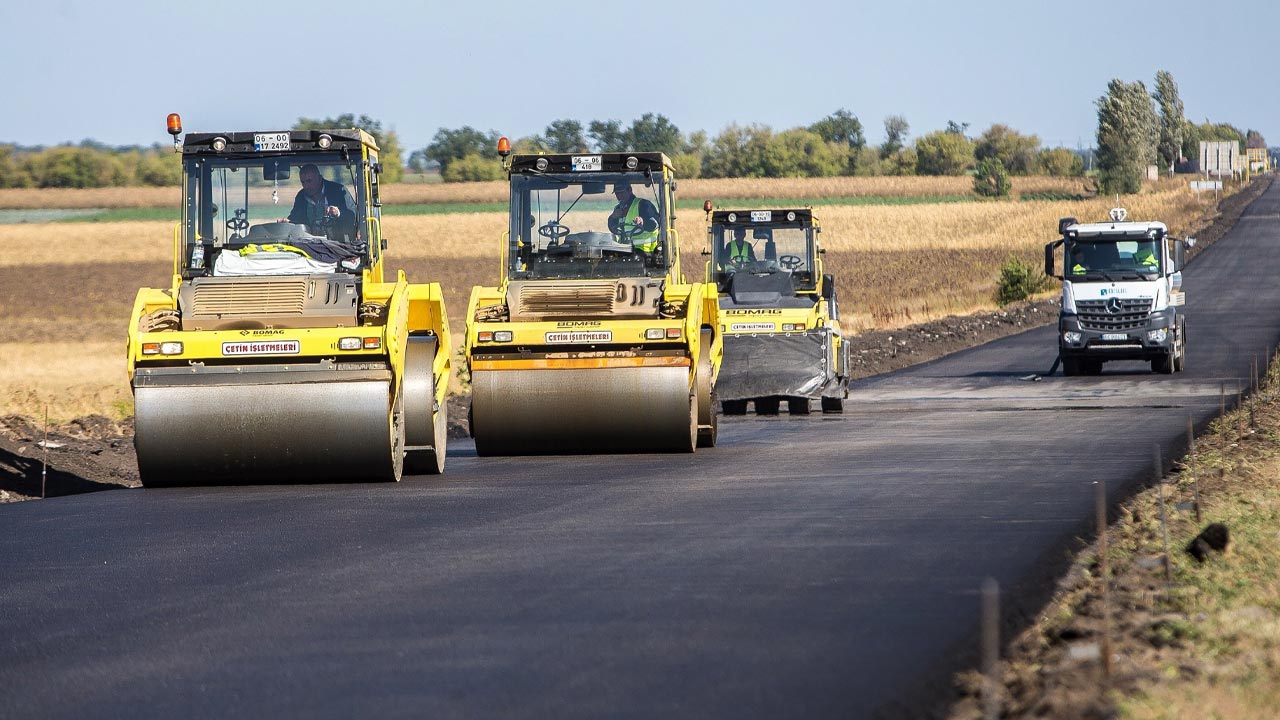
Within the framework of the national program “Great Construction” in Ukraine, the first concrete road H-31 Dnipro – Tsarychanka – Kobelyaki – Reshetylovka is being built
However, for a state that plans to spend money efficiently and at the same time provide high-quality infrastructure, one concrete road is clearly not enough.
Since the beginning of March, the national project “Great Construction” has been underway in Ukraine.
The state plans to build more than 100 schools, 100 kindergartens, 100 stadiums and 200 new hospital reception departments within a year. In addition, the program plans to overhaul or build from scratch 6,500 km of roads by the end of 2020.
According to the project management, “Great Construction” is based on the principles of energy efficiency and, accordingly, saving communities’ money.
Despite the ambitions and scale of the program, asphalt roads will still be used, which does not meet the innovative principles of the project. Unlike concrete, asphalt has a shorter service life and, in addition, cannot withstand heat, frost, or loads.
Asphalt also has no advantages from an environmental point of view, while concrete is based exclusively on natural ingredients.
World practice VS Ukraine
Concrete roads are being actively built all over the world. For example, the Estonian Union of Building Materials Manufacturers has calculated that the costs of concrete pavement are 40% lower than asphalt pavement, if we compare the costs of covering a 2 + 2 highway over the entire life cycle of the road under comparable conditions.
For a long time, it was believed in Estonia that traffic loads and traffic frequency had not reached the level that would make this technology profitable. Now this statement has been refuted and the country is starting to calculate in which areas it is advisable to build concrete roads.
A study by the Ukrainian Institute for the Future demonstrates the economic effects of building concrete roads by 2030 in Ukraine. The study states that the economic effect on Ukraine’s GDP from the construction of cement-concrete roads will be from $8.5 to $19.4 billion, while for asphalt-concrete roads it will be a maximum of $3.3 billion.
In the EU countries, the number of cement-concrete roads is about 40%, in the USA it is 60%. In Ukraine, this figure is only 1%. At the same time, only 26% of Ukrainian roads are capable of supporting the load of heavy vehicles, which indicates an acute problem with the quality of road infrastructure. This can lead to a significant deterioration in road safety, as well as a decrease in the average speed of trucks.
Pavlo Kachur, the head of the Ukrcement Cement Manufacturers Association, notes that giving preference to asphalt roads means remaining import-dependent: “The advantages of cement-concrete roads are obvious, but Ukraine continues to build asphalt roads, even despite the numerous disadvantages of such a coating.
First of all, it is necessary to understand that asphalt pavement is made on the basis of bitumen, a material made from refined oil. That is, this product is overwhelmingly imported. Being dependent on imports is a bad strategy in this case, especially now, when the Ukrainian economy is experiencing a noticeable decline due to the corona crisis.
Every hryvnia matters, and it turns out that we are spending it on imported bitumen. According to a preliminary estimate, more than 20 billion hryvnias will be spent on the purchase of bitumen this year. We could definitely leave a significant part of these funds in the Ukrainian economy!
Cement-concrete roads are based exclusively on the local cost component. This not only eliminates import dependence, but also provides thousands of jobs and millions in revenue to the state budget.”
The widespread myth about the high cost of concrete roads in Ukraine is not true. Taking into account the duration of the life cycle, concrete roads are much more profitable. Thus, the life cycle of cement concrete pavement is 30-35 years, and in the USA, for example, as much as 40-60 years. The life cycle of asphalt pavement is only 10-12 years. In addition, the warranty period (the period for which construction companies assume warranty obligations during major repairs) is even shorter. For asphalt, it is 5-8 years, for concrete roads – 20-25 years.
It is worth noting that all trends indicate that road traffic will only increase over time. For example, the international engineering and design company ARUP predicts that the number of cars on the world’s roads will increase by 3% annually, and most cars will move on city roads.
This indicates that road infrastructure needs to change — to be more innovative, durable, and sustainable. The construction of cement concrete roads could be such a solution.
Why are concrete roads so strong?
It is worth noting that the thickness of the concrete pavement together with the compacted soil is about 1.5 meters. A concrete road has three layers: earth, a subgrade layer — mechanically compacted crushed stone — and the concrete pavement itself, which can have several layers at once.
The so-called heavy concrete (top layer) has a thickness of about 26 cm. In addition, reinforcing elements are installed in the concrete layer, which add additional strength to the pavement, and also prevent the concrete from shifting during cutting of joints.
Thanks to this, concrete roads are more resistant to large-sized and heavy transport: a large and strong concrete slab does not bend under the wheels of trucks. This is the key to the integrity of the roadbed, and therefore its long-term operation.
Market experts also see another indirect economic effect in this: reducing fuel consumption for cars. This becomes noticeable not in each specific case, but on the scale of the entire country, which, moreover, imports fuel.
Thus, by delaying the implementation of concrete pavement, the state is spending unnecessary funds, making economically unprofitable decisions. The “Large Construction” program is currently demonstrating excellent results, it is advisable to only make a few adjustments and focus on more innovative, environmentally friendly and energy-efficient road construction technologies in the future.
Author: Anna Gergel
